IMME a partner in the European CYberSafety VI project led by the Cyprus Pedagogical Institute
September 30, 2026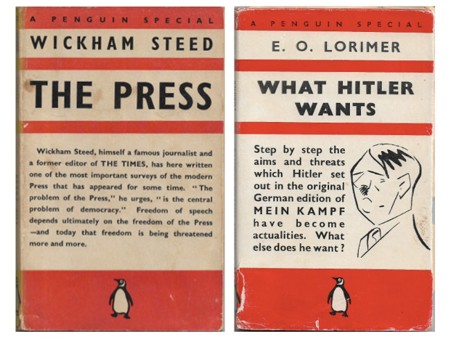
Press Washing
Penguin classics hold lessons for media sanitising far-right narratives
Nicholas Karides, 4 November, 2026
Our surrender to the screen and to the unchecked data that mechanical intelligence spits out can deprive us of serendipitous offerings languishing on dusted bookshelves. Fastness beats slowness, but slowness holds all the treasures. The Penguins above were published in November 1938 (left) and in January 1939 (right).
Emily Lorimer critically assessed Nazi ideology and sought to counter British underestimation of Hitler’s intentions. We now know more than she did then about what Hitler had wanted. It is tempting but wrong (as Nassim Nicholas Taleb warns) to anachronistically and sanctimoniously hold to account those who didn’t see what had been coming. Not so, perhaps, for those who did see it but didn’t do anything about it.
In 2026 we can and should agree to be far stricter with ourselves about what we actually know is happening and what it means. Yet, we are not rising to the task.
Part of our inability to respond to the Trumps and Netanyahus is that, in different but equally effective ways to 1938, public opinion globally is duped, distracted, desensitised, or unforgivably ignorant about what is going on. Algorithmic social media and machine intelligence may be largely to blame but the mainstream Press is no less guilty.
On Tuesday this week the most widely-read Cypriot newspaper Phileleftheros (translated The Liberal) carried an opinion piece (below1) by its senior political reporter under the curious title “Cyprus is not threatened by [the far-right neo-fascist party] ELAM, just as Italy was not threatened by Meloni”.
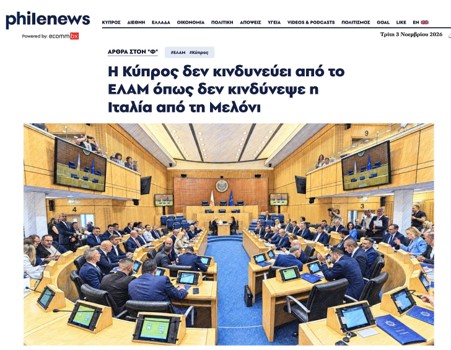
He explained: “The scaremongering about ELAM is nothing new, nor does it concern only the future. Similar fears were raised in the recent past, during the parliamentary elections. The same concerns were voiced much earlier, when ELAM first appeared on the political scene, and later, when it entered Parliament. However, none of these things has happened. So why should they happen in the future?” It’s not even subtle.
He then argued that Meloni’s triad “God, Homeland, Family” served as a symbol of resistance against what he labelled “the so-called ‘woke’ agenda” and globalization.
The reporter is clearly entitled to his views and it is possible, as Emily Lorimer wrote of the British Press in 1939, that he is merely ‘underestimating’ the far right’s intentions. He may also, though he should not, be ignorant of the damage that Meloni has actually done to the freedom of the press in Italy2. But the text’s clumsily insidious framing can only be interpreted as what is now a widespread media trend to press-wash neo-fascism.
It seems a bit suspect that the editorial processes of a newspaper that calls itself ‘The Liberal’ wouldn’t have caught such a blatant attempt —not merely by a guest columnist but by its staff— to normalise a populist far-right nationalist party.
Our Media Institute’s3 role is, among others, to pay attention to what the media write or avoid writing, what they imply, how they choose their words and images and, ultimately, to defend and promote the integrity of quality journalism. It is, equally of course, to defend media freedom, the opinion writer’s including. But it is also to expose those who in the name of that freedom fail to come clean to their readers.
In democracies the media are afforded a privileged degree of freedom in return for a covenant of trust with the public and always -always- with an obligation to defend the democracy that offers them that freedom.
The Institute currently runs news literacy modules for 17-year olds in schools across Cyprus stressing the connection between Journalism and Democracy. Phileleftheros has just made it difficult for us to refer to it as we had in the past given that it is the oldest and largest Greek language newspaper in the country. It was never perfect and it certainly isn’t today. But at no point in its history was it ever in favour of those intent on eroding democracy.
For some time now the far right in Cyprus (in Greek ELAM stands for the National Popular Front) has been press-washed in a slow laundering cycle across almost all media and, with their help, has managed to blend into the political landscape. Its electoral showing increased from 1 percent in 2011 to 11 percent in 2026 and it now occupies 8 seats in the 56-member Cypriot parliamentary chamber. Its deputies preside over two parliamentary Committees, Defence and Transport. It is forgotten that it had sought but failed to secure chairmanship of the Committee on Education.
Like most far-right parties in Europe the Cypriot far-right have smoothed their tone and messaging and have infiltrated the centre-right’s discourse. Their press-assisted sanitising has made them seem less threatening even though their ideology remains ruthlessly exclusionary and nationalist.
Importantly, the Cypriot far-right has maneuvered itself into a position of potential kingmaker for the next presidential elections in February 2028 while Phileleftheros’ new corporate ownership’s political affiliations are widely acknowledged to favour the incumbent president. In Wickham Steed’s Penguin above, he warned that the Press should not concede its journalistic integrity to considerations of money-making or to serve the itch of the government and to find instead the courage to understand that it owes its allegiance to the public, and the public alone.
Neo-fascism is loud by nature but quiet by method. It is therefore rather disappointing, even embarrassing, when the Press, like in the 1930s, turns a blind eye to their deceptive narratives. It is outright shameful and potentially catastrophic when it casually spreads them itself.
- https://www.philenews.com/apopsis/arthra-apo-f/article/1789704/kypros-den-kindynevei-apo-elam-meloni/ ↩
- From the 2025 TEPSA report on Italy: “Meloni has become notorious for her refusal to speak to reporters unless they agree to comply with her strict editorial demands. RAI journalists have shared that they have been barred from asking the Prime Minister questions on sensitive topics during television appearances. Journalists at the Sole 24 Ore, Italy’s main economic newspaper, organised six days of strikes in protest against the publication of a rare print interview with Meloni, which they deemed overly deferential and ‘softball’. In several instances, Meloni and her staff have had tense exchanges with the press, including allegations of national reporters wanting to “humiliate” the government during foreign visits (which have led to the intentional exclusion of Italian journalists from press conferences, or a refusal to hold them at all). She has dismissed critical coverage of her government as ‘fake news’… ” https://tepsa.eu/analysis/melonis-italy-puts-media-freedom-in-the-back-seat/ ↩
- www.imme-universitas.org ↩